Powder coating has become a standard finishing process across U.S. manufacturing, from automotive and construction to appliances and general industrial production.
Its popularity comes down to a few key advantages:
- Durable, high-quality finishes
- Consistent and controllable application
- Environmentally friendly process (no VOC solvents, near 100% solids)
As demand grows, manufacturers face an important decision:
Which type of powder coating system best fits their operation?
In the U.S., most facilities rely on a combination of batch systems, automated lines, and specialized application methods, depending on production volume, part complexity, and flexibility requirements.
Understanding the Powder Coating Process
Regardless of system type, all powder coating operations follow the same three core stages:
1. Pretreatment
Parts are cleaned and prepared to ensure proper adhesion and corrosion resistance. This step often includes:
- Chemical cleaning
- Rinsing
- Surface preparation (e.g., SSPC standards)
Pretreatment is important as poor preparation leads to coating failure regardless of application quality.
2. Coating
Powder is applied to the part surface using one of several methods, most commonly electrostatic spray.
This stage determines:
- Film thickness
- Coverage consistency
- Transfer efficiency
The application method and operator technique at this stage directly influence every quality outcome downstream, making it the most critical control point in the entire powder coating process.
3. Curing
Parts are heated to bond the powder into a continuous, durable coating.
Curing performance directly affects:
- Mechanical strength
- Chemical resistance
- Final finish quality
Parts are heated to bond the powder into a continuous, durable coating. Curing performance directly affects mechanical strength, chemical resistance, and final finish quality. For a deeper technical breakdown of the physics behind this stage, please read our article on the physics behind powder coating.
Most Common Powder Coating Methods
While system layout varies depending on part geometry, production volume, and facility constraints, application methods in the U.S. generally fall into three categories. Each approach has its own set of tradeoffs in terms of cost, efficiency, and the types of parts it handles best, so the right choice depends heavily on the specific demands of the operation rather than any single universal standard.
Electrostatic Spray Coating (Industry Standard)
Electrostatic coating is the most widely used method across U.S. powder coating systems. Its widespread adoption comes down to a combination of high efficiency, precise control, and versatility. It performs reliably across most part types and scales naturally from small manual operations to fully automated high-volume lines, making it the default choice for most facilities.
In this process:
- Powder particles are electrically charged
- Parts are grounded
- The powder is attracted and adheres to the surface
Why it’s widely used:
- High efficiency and control
- Suitable for most part types
- Scalable for both manual and automated systems
Limitations:
- Faraday cage effect in complex geometries
- Requires parameter tuning (voltage, airflow, gun settings)
This is where optimization becomes critical, and what coatingAI specializes in, especially in high-volume operations where small inefficiencies compound quickly across thousands of parts. For a closer look at how transfer efficiency and parameter control affect powder consumption and coating consistency, see transfer efficiency and powder savings.
Flocking (Hot Coating)
Flocking is used when electrostatic application struggles with complex geometries, effectively stepping in where the standard method’s limitations are most pronounced. Rather than relying on electrical charge to attract powder to the surface, flocking takes a fundamentally different approach that sidesteps the Faraday cage problem entirely.
In this method:
- Parts are preheated
- Powder is applied without electrical charge
- Powder melts and adheres on contact
Best suited for:
- Deep recesses
- Complex shapes
- Faraday-sensitive areas
The tradeoff is that flocking is more energy-intensive and less efficient for simple, high-volume parts, where electrostatic methods remain the better choice. It also requires precise preheat temperature control, too cold and the powder won’t bond properly, too hot and you risk uneven flow or surface defects. For that reason, flocking tends to be reserved for specific part types where it offers a clear advantage, rather than used as a general-purpose application method.
Fluidized Bed Dipping
Fluidized bed dipping is a specialty application method designed for situations where conventional spray techniques simply cannot deliver the coverage or thickness required. While it represents a smaller share of overall powder coating operations, it fills a critical niche for certain part types and performance requirements.
In this method:
- Heated parts are submerged in a fluidized powder bed
- Powder melts and forms a coating upon contact
Common use cases:
- Valves and fittings
- Parts requiring internal coating
- Thick or protective coatings
The primary limitations are throughput and part size. The fluidized bed is a fixed-volume system, so parts must fit within it, and the process is inherently slower and more manual than automated spray lines. For high-volume production of simple parts, it would be an inefficient choice. But for the specialty applications it was designed for, no other method comes close to matching its coverage consistency and coating integrity.
Batch vs. Automated Systems: What’s More Common in the US?
In practice, most U.S. manufacturers often use a combination of both, and the distinction between the two is less about technology preference and more about matching the system to the demands of the work.
Batch systems load, coat, and cure parts in discrete groups, making them inherently flexible. A batch line can accommodate a wide variety of part sizes, shapes, and colors in a single shift with quick changeovers, something that would be impractical on a rigid automated line but is routine for job shops and custom fabricators handling diverse orders.
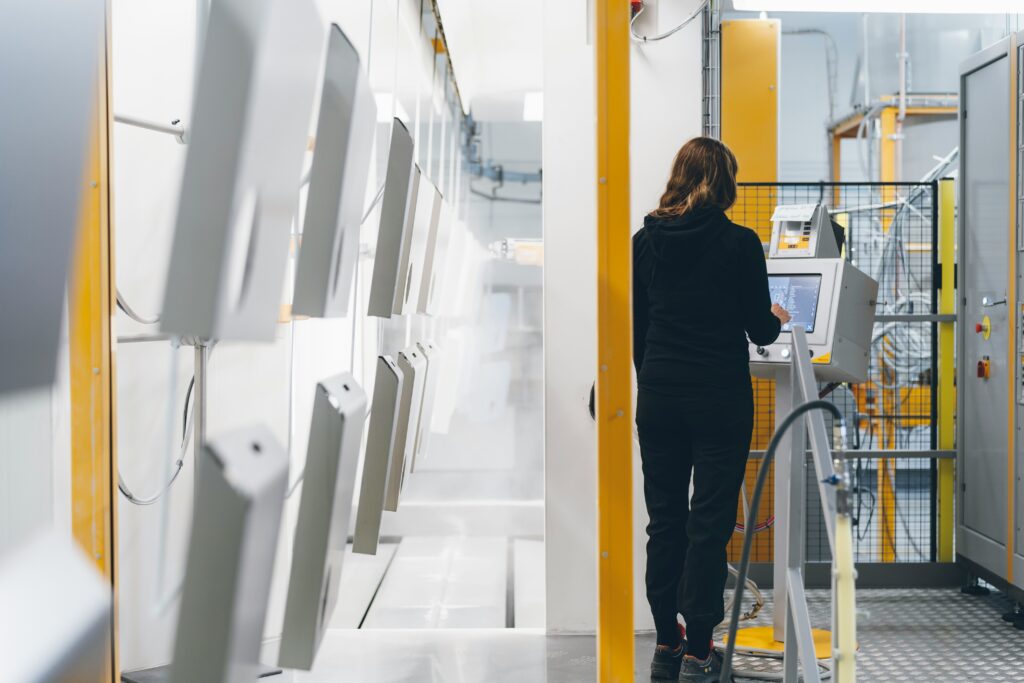
Automated systems move parts continuously through the coating process on a conveyor, with pretreatment, application, and curing happening in sequence without manual intervention. This drives down labor costs and increases throughput, but the advantage is most pronounced in high-volume, low-variation production, the same part, same color, same specification, running in large quantities.
The choice depends largely depends on the following:
- Production volume
- Part complexity
- Delivery timelines
- Customer requirements
There is no single “best” system, only the one that best fits your operations.
The Shift Toward Smarter Powder Coating Systems
Across the U.S., even well-designed powder coating systems, batch or automated, face persistent challenges that equipment alone cannot solve. Inconsistent film thickness, powder waste, and performance variability across shifts are rarely equipment problems.
These are rarely equipment problems. They are process control problems. Meaningful performance gains come from tighter control over application parameters rather than hardware upgrades.
This is where intelligent control systems come in.
Blueprint™ OS integrates with existing powder coating systems to deliver:
- Real-time monitoring of airflow and electrostatics
- Automatic parameter tuning to maintain consistent results
- Predictive alerts for wear and performance drift
- Reduced manual dependency without replacing operators
Whether an operation runs batch, automated, or a hybrid of both, the manufacturers gaining a competitive edge are those treating equipment, process control and data-driven optimization as core parts of their system, not afterthoughts.