Artificial intelligence is becoming a common topic in manufacturing, but for most powder coaters the question is still very practical:
What does AI actually do on a coating line—and how disruptive is it to implement?
Blueprint OS was designed specifically to answer that question in a way that fits real-world powder coating operations. The system is introduced through a short, controlled onsite pilot, conducted on a live production line, with minimal disruption.
The objective is straightforward: prove measurable powder savings and improved coating consistency under normal production conditions.
And the pilot is no risk, contact us to schedule a 4-hour onsite visit and see the results on your line.
If we do not demonstrate at least 10% powder savings during the onsite visit, there is no charge.
What the Onsite AI Pilot Is Designed to Prove
The pilot is not a software demonstration or simulation. It is a hands-on, data-driven optimization performed directly on one representative booth or line.
During the visit, Blueprint OS is used to:
- Quantify current coating variation
- Identify gun-to-gun output differences
- Reduce film thickness variation
- Safely lower average film build while staying within specification
All measurements are taken on real parts, using the plant’s normal process.
Typical Pilot Duration and Production Impact
- Total onsite time: approximately 3–4 hours per booth
- Production stoppage: one planned pause of 20–30 minutes
All other steps are completed while the line continues running.
The pilot is structured to fit within a normal production day.
Step-by-Step: What Happens During the Pilot
1. Line Walk and Scope Confirmation (10–15 minutes)
The visit begins with a short walkthrough of the selected booth or line to confirm:
- Gun configuration (fixed or reciprocating)
- Powder(s) and part types being run
- Film thickness specifications and quality requirements
- Measurement method for film build
This step also allows operators and technicians to highlight recurring challenges or known variation points.
2. Baseline Performance Benchmarking (30–60 minutes, during production)
With the line running normally, the current process is documented:
- Recipe settings and gun configuration
- Film thickness distribution across the part
- Areas of excessive variation or overbuild
At this stage, no adjustments are made. The goal is to establish a reliable baseline that reflects actual day-to-day performance.
3. Short Production Pause for Gun Output Verification (20–30 minutes)
This is the only planned production stop.
During this window, guns are bagged at defined setpoints to measure actual powder output, rather than relying on controller settings alone. This step typically reveals:
- Significant gun-to-gun output variation
- Drift caused by venturi wear, nozzle condition, or line restrictions
Because this process becomes the standard weekly 20-minute preventive check, operators are encouraged to observe or assist.
4. Reciprocator Optimization (If Applicable)
If the booth uses automatically controlled reciprocating guns, reciprocator speed, stroke, and positioning are optimized during the pilot.
For manually adjusted systems, this optimization is completed during onboarding.
Spray geometry is typically revisited only periodically (every few months), while gun output is verified weekly.
5. AI-Driven Optimization and Verification (45–90 minutes, during production)
Using the collected data, Blueprint OS applies optimization logic to:
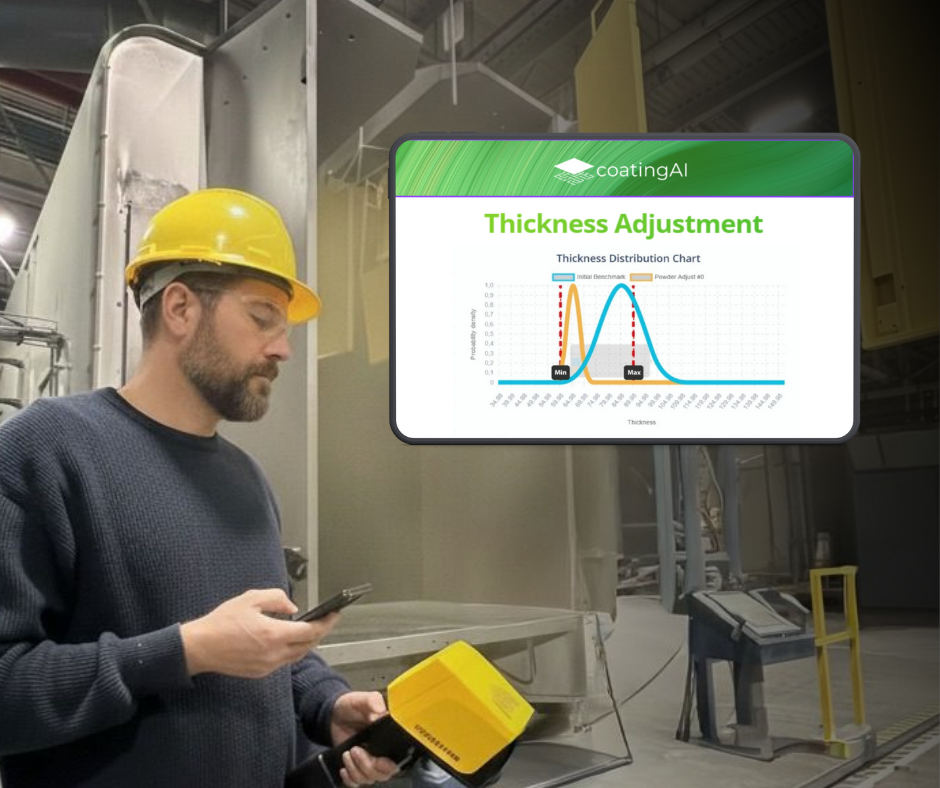
- Tighten film thickness distribution (reduce standard deviation)
- Identify the lowest achievable average thickness that still meets specification
Updated settings are applied while production continues, and thickness measurements are repeated to confirm improvement.
If any gun remains out of range, corrective actions are clearly identified and verified.
6. Results Review and Savings Confirmation (15–20 minutes)
Before leaving the site, results are reviewed with the team:
- Before vs. after thickness distribution
- Verified powder savings potential
- Recommended next steps for maintaining and scaling results
Savings are verified using the appropriate method:
- Spray-to-waste: reduced grams per minute at the guns
- Reclaim: reduced average film build while staying above minimum spec
In both cases, results are visible the same day.
What Comes After the Pilot: Keeping the Line Optimized
The pilot demonstrates what is possible. Long-term value comes from consistency.
Blueprint OS is designed around a simple, repeatable weekly routine:
- Approximately 20 minutes per booth
- Gun output verification
- Thickness measurement
- Guided adjustments based on system recommendations
This approach removes guesswork, reduces dependence on tribal knowledge, and helps maintain consistent results across shifts and facilities.
Why the Pilot Is No Risk
The commercial model is intentionally simple:
- Guaranteed minimum: 10% powder savings
- Requirement: savings must be demonstrated during the onsite pilot
- If not demonstrated: no charge
This allows coating teams to evaluate the technology based on data, not promises.
Why Many Plants Start Here
The pilot answers the most important operational questions quickly:
- Will this work on our line?
- Can operators realistically maintain it?
- Are the savings measurable and repeatable?
In about four hours, those questions are answered with real data. Talk to our team about running a no-risk onsite AI pilot on your powder coating line.